
- Rahmatulla Syed
- 0 Comments
What Makes Raw Honey Different from Processed Honey?
Honey may look simple from the outside, but not all honey is the same. While both raw and processed honey come from bees, the way they are handled after harvest makes a major difference in their texture, aroma, nutritional value, and overall authenticity. If you are choosing honey for purity, wellness, and natural taste, understanding this difference matters.
Understanding the Difference Begins at Harvest
Raw honey is honey in its closest natural form. It is harvested after bees have fully ripened it inside the comb and sealed it with a wax cap. This means the honey has reached a stable stage of maturity before it is collected. When handled carefully and extracted without heat, it retains much of what makes honey special in the first place: its natural enzymes, floral aroma, trace pollen, and delicate character.
Processed honey, on the other hand, is usually heated and filtered more aggressively to create a smoother, clearer, and more uniform product. While this may improve shelf appearance and make the honey easier to pour, it can also reduce many of the natural qualities that health-conscious consumers are looking for.
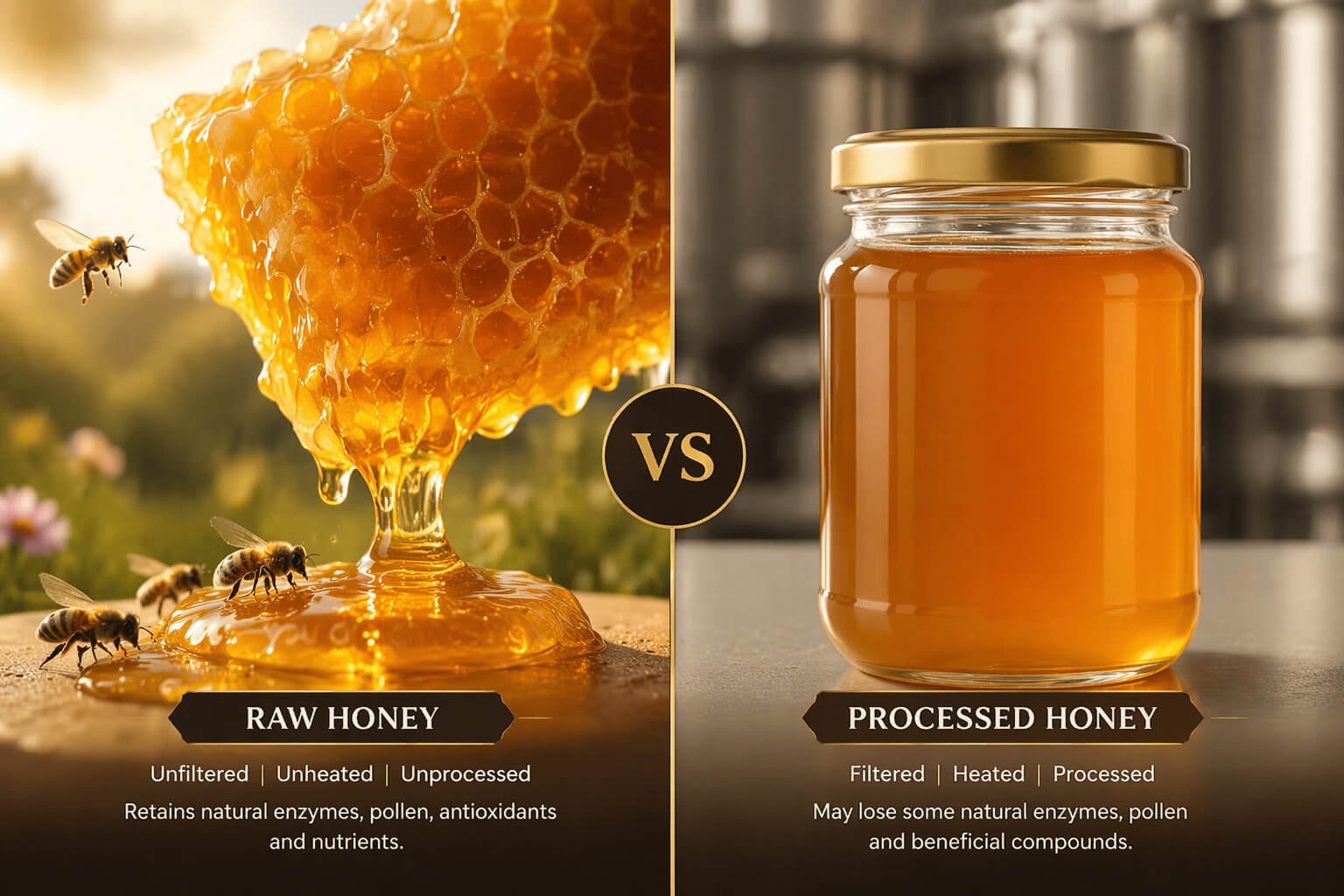
Raw Honey vs Processed Honey
Closer to Nature
Raw honey is typically extracted without heat and with minimal filtration. Because of this, it may contain tiny traces of pollen, natural enzymes, antioxidants, and aromatic compounds that reflect the flowers visited by the bees.
- Harvested after natural ripening inside the hive
- Usually not heated during extraction
- Retains natural texture, aroma, and floral variation
- May crystallize over time, which is a natural sign of authenticity
Standardized for Appearance
Processed honey is often heated to delay crystallization and filtered to remove suspended particles. This creates a smoother and more uniform product, but it may also strip away some of the natural character found in less altered honey.
- Often heated for easier handling and bottling
- Filtered to produce a very clear appearance
- More uniform in texture and look
- May lose part of its original aroma and natural complexity
Why Heat Makes Such a Big Difference
One of the biggest differences between raw and processed honey is heat. Honey is a naturally sensitive food. Excessive heating can affect the delicate compounds that give raw honey its natural character. These include enzymes, volatile aroma compounds, and certain antioxidants that contribute to honey’s uniqueness.
In many commercial systems, heat is used to make honey thinner, easier to filter, and slower to crystallize. From a manufacturing perspective, this improves convenience. From a natural quality perspective, however, it can move honey further away from its original state.
That is why truly raw honey is often described as being handled gently. It is not forced into looking perfectly clear or behaving like a syrup. Instead, it is respected as a natural food with its own texture, thickness, and seasonal personality.
Natural Enzymes, Antioxidants, and Trace Pollen
Raw honey contains naturally occurring compounds that make it more than just a sweetener. These include enzymes such as invertase and glucose oxidase, as well as antioxidants like flavonoids and phenolic compounds. Trace pollen may also remain in raw honey, helping preserve part of its botanical identity.
Processed honey may still be sweet and enjoyable, but it often loses some of this natural complexity during heating and heavy filtration. This is one reason raw honey is preferred by people who want a food that feels less industrial and more authentic.
Natural Enzymes
Raw honey better preserves delicate enzymes that are naturally introduced during the honey-making process inside the hive.
Antioxidant Value
Because it is less altered, raw honey is often appreciated for its naturally occurring antioxidant compounds.
Botanical Character
Floral source influences the aroma, color, and taste of honey. Raw honey expresses this more clearly.
Authentic Texture
Thickness, slight cloudiness, and natural crystallization are often part of genuine raw honey.
Why Raw Honey Does Not Always Look Perfectly Clear
Many people assume that very clear, ultra-smooth honey must be “better.” In reality, the opposite can often be true. Raw honey may appear slightly cloudy, dense, or textured because it has not been stripped of every natural particle. This is not a flaw. It is often part of what makes raw honey real.
Raw honey can also crystallize over time. This is a natural process influenced by factors such as floral source, glucose content, and storage temperature. Crystallization does not mean the honey has spoiled. In fact, it is commonly seen as a sign that the honey has remained closer to its natural composition.
Taste, Aroma, and Floral Identity
One of the most beautiful qualities of raw honey is that it carries the signature of the flowers from which it came. Depending on the landscape, season, and forage available to the bees, honey can vary in color, thickness, fragrance, and taste. Some batches may be delicate and floral, while others may be deeper, earthier, or more robust.
Processed honey tends to be more standardized. That uniformity may suit large-scale commercial distribution, but it often comes at the cost of the subtle differences that make natural honey exciting and meaningful.
Why Health-Conscious Consumers Prefer Raw Honey
People who choose raw honey are often looking for more than sweetness. They want a natural food that feels clean, minimally altered, and true to its source. Raw honey is widely appreciated for its natural antioxidants, its rich flavor, and the fact that it is often handled without aggressive industrial processing.
It is also commonly used in daily wellness routines. Many people enjoy it in warm water, herbal tea, breakfast bowls, desserts, or simply by the spoon. Its role in traditional wellness systems has added to its long-standing appeal.
How to Choose Better Honey
If you want honey that remains close to nature, look beyond the label design and focus on how the honey is produced. Ask whether it is naturally ripened in the hive. Find out whether it is heated during extraction. Understand whether it is simply filtered or heavily processed for a polished supermarket look.
The best honey brands are transparent about their harvesting methods. They explain how the bees are managed, how the honey is collected, and how its natural qualities are preserved. This is where trust matters just as much as taste.
Frequently Asked Questions
No. Crystallization is a natural process in genuine honey and often occurs faster in raw honey because it has not been heavily altered.
Not necessarily sweeter, but it is often richer in flavor, aroma, and mouthfeel because more of its natural character remains intact.
Because floral source, season, and geography all influence honey naturally. Variation is part of what makes real honey unique.
Final Thoughts
The difference between raw honey and processed honey is not just technical—it is meaningful. Raw honey offers a closer connection to the hive, the flowers, and the natural work of bees. It is valued for its authentic texture, rich aroma, natural compounds, and minimal handling.
If you believe honey should remain as close as possible to the way nature creates it, then raw, naturally ripened, gently handled honey is the better choice.